
For procurement teams evaluating ABS sensor sourcing, face-to-face assessment at a major China auto parts expo eliminates the guesswork of online-only vetting. You can test a sensor’s response time, review its connector plating, and question the engineer who signs off on the production line—all in one half-hour booth visit. Our exhibition marketing group has matched thousands of global buyers with Chinese manufacturers through APES Shanghai and similar platforms, and we’ve seen that the most durable supply relationships start with a candid conversation at a stand, not an Alibaba inquiry.
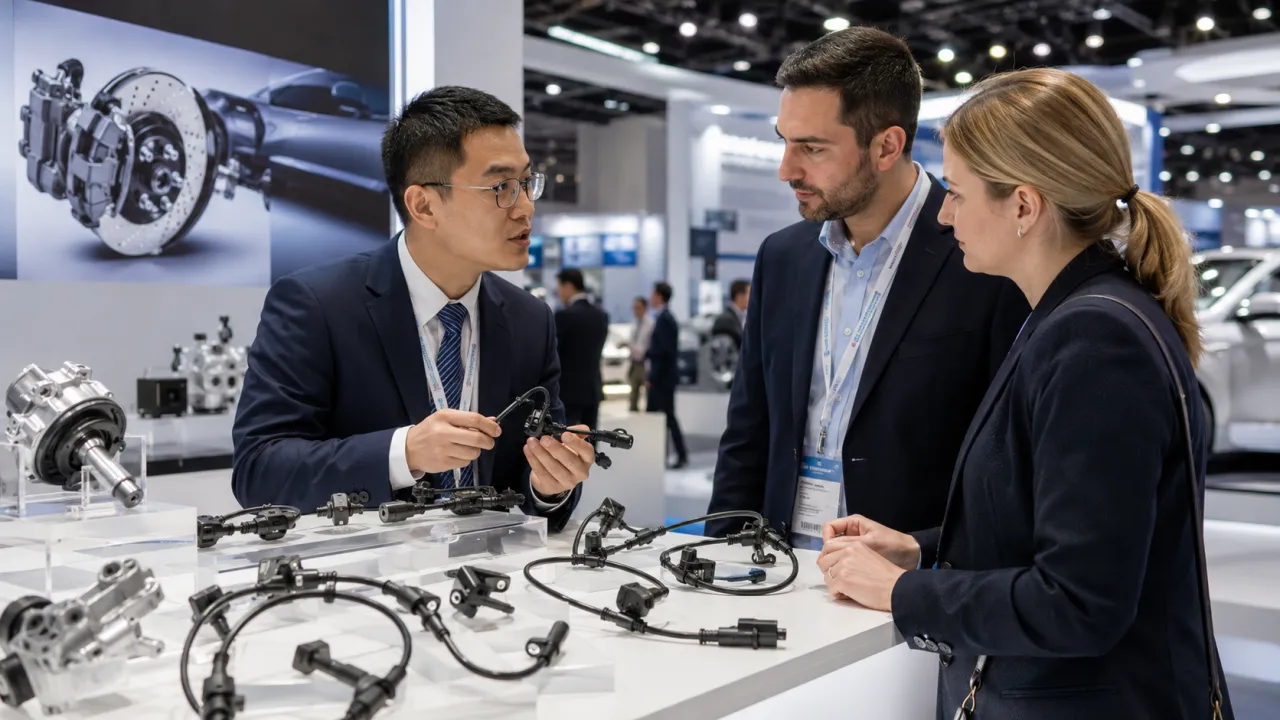
Why a Trade Show Beats the Catalogue for ABS Sensor Sourcing
A distributor’s catalogue lists specs. A booth reveals whether those specs translate to a repeatable manufacturing process. At exhibitions devoted to the automotive aftermarket, you can observe the machining marks on a sensor housing, ask about the type of potting compound used to seal the electronics, and verify that samples handle the full operating temperature range your application demands. Buyers who attend the right China trade fair report that the share of suppliers passing first-article inspection rises noticeably compared to those sourced through directories alone, because catalogue selection filters for marketing capability rather than production discipline. The cost of a flight and a badge is trivial against a container-load of field failures.
Which China Auto Parts Expos Attract Quality ABS Sensor Manufacturers
Not every exhibition carries equal weight among sensor fabricators. The table below compares three events where ABS wheel speed sensor specialists regularly exhibit, based on exhibitor profile, buyer geography, and the type of sensor technology showcased.
| Exhibition | Typical ABS Sensor Exhibitor Profile | Buyer Region Focus | Sensor Tech Emphasis |
|---|---|---|---|
| APES Shanghai (NECC) | Zhejiang, Hebei, Shiyan medium-large tier-1/2 manufacturers | Global, with strong Middle East, Southeast Asia, South America attendance | Passive Hall-effect and magneto-resistive sensors for passenger vehicle and commercial truck markets |
| Automechanika Shanghai | International brand tier-1s plus domestic OEM-focused fabricators | Europe and North America heavy, recent Southeast Asia growth | Active wheel speed sensors, integrated bearing/sensor assemblies |
| CAPAFAIR Ningbo | Ningbo-area small-to-mid fabricators, many export-only | Strong in Eastern Europe, Africa, South Asia | Budget passive ABS sensors, sensor sub-harnesses |
If your target cost per sensor and minimum order quantity match a Ningbo-area sub-supplier, Ningbo makes sense. If you need IATF 16949-certified active sensors for an OE service program, Shanghai’s larger fairs surface the right suppliers faster.
How to Shortlist ABS Sensor Exhibitors Before You Land
Two weeks before the show, pull the official exhibitor list and filter by company location first—not by category. An ABS sensor manufacturer registered in Rui’an, Zhejiang, or Qiaotou Town in Yuhuan is statistically more likely to own its magnetic element calibration line than a trader in Shanghai with no factory address. Then cross-check each prospect’s website for a physical factory address and ISO 9001/IATF 16949 certificate number you can later verify on the certifying body’s database. When you email to request a meeting, ask for one technical drawing with tolerances—any sensor maker that cannot produce a dimensioned drawing within 48 hours is likely not the manufacturer. Our internal data from APES event registration shows that exhibitors with publicly listed certification numbers and zero trader intermediaries book meetings earlier and convert follow-up quotes at a measurably higher rate.
Regional Industrial Clusters That Shape ABS Sensor Supply
The sensor supply chain is concentrated in a handful of counties. Yuhuan in Zhejiang hosts dozens of chassis and braking system component manufacturers, many of which produce ABS wheel speed sensors as a core line. Rui’an, also in Zhejiang, specializes in automotive electronics and sensor assemblies, with a dense ecosystem of magnetic encoder ring suppliers nearby. In Hebei, Qinghe County is better known for filters and rubber seals, but a growing network of wiring harness and sensor connector shops supports the brake sensor segment. Shiyan in Hubei feeds the commercial vehicle ABS market, with suppliers frequently displaying at Shanghai fairs to connect with export buyers. Knowing which cluster dominates which component lets you spend your booth time with the right zip code—a practical edge that no online supplier platform replicates.
What to Inspect at an ABS Sensor Supplier’s Booth
Bring a pair of calipers, a magnifier, and a smartphone with a sensor datasheet library. When you reach the booth, inspect the sensor’s connector pin plating thickness—ask what plating spec is used and whether they perform salt spray testing to verify it. Request a live reading on their test bench if they have one; a hall-effect sensor’s output waveform can tell you if the magnetic bias is stable across the air gap range. Examine the overmolding gate location for signs of resin starvation or knit lines near the sensor tip, which indicate suboptimal mold flow and can predict moisture ingress later. Ask how they define “operating temperature range”—a supplier who quotes -40°C to 150°C should be able to show you the thermal shock profile used during qualification. These checks take under ten minutes and separate a solid production house from a box shifter.
If your program involves an ABS sensor with an integrated harness or a unique connector footprint, it is worth confirming the connector molding capability on the spot—our team often sees connectors become the bottleneck. For a second opinion on which exhibitor can meet a non-standard specification, reach out at apeschina@huamogroup.com before the show and we’ll flag the right stands.
Turning Exhibitor Meetings into Production Partnerships
After the show, grade your shortlist on three criteria: whether they provided the technical drawing on time, whether the person at the booth could discuss the sensor’s magnetic design parameters, and whether they proposed a realistic pre-production sample lead time (typically four to six weeks for a custom ABS sensor). Schedule a factory visit for the top two candidates within the same trip; verify that the production floor runs the same equipment brand and quality control stations shown in the booth video. Before finalising the contract, request a process capability study (Cpk) on the air gap output voltage tolerance—a Cpk below 1.33 is a signal to look harder. The exhibition gives you a front-row view of the supplier’s sales capability; the follow-up reveals their engineering depth.
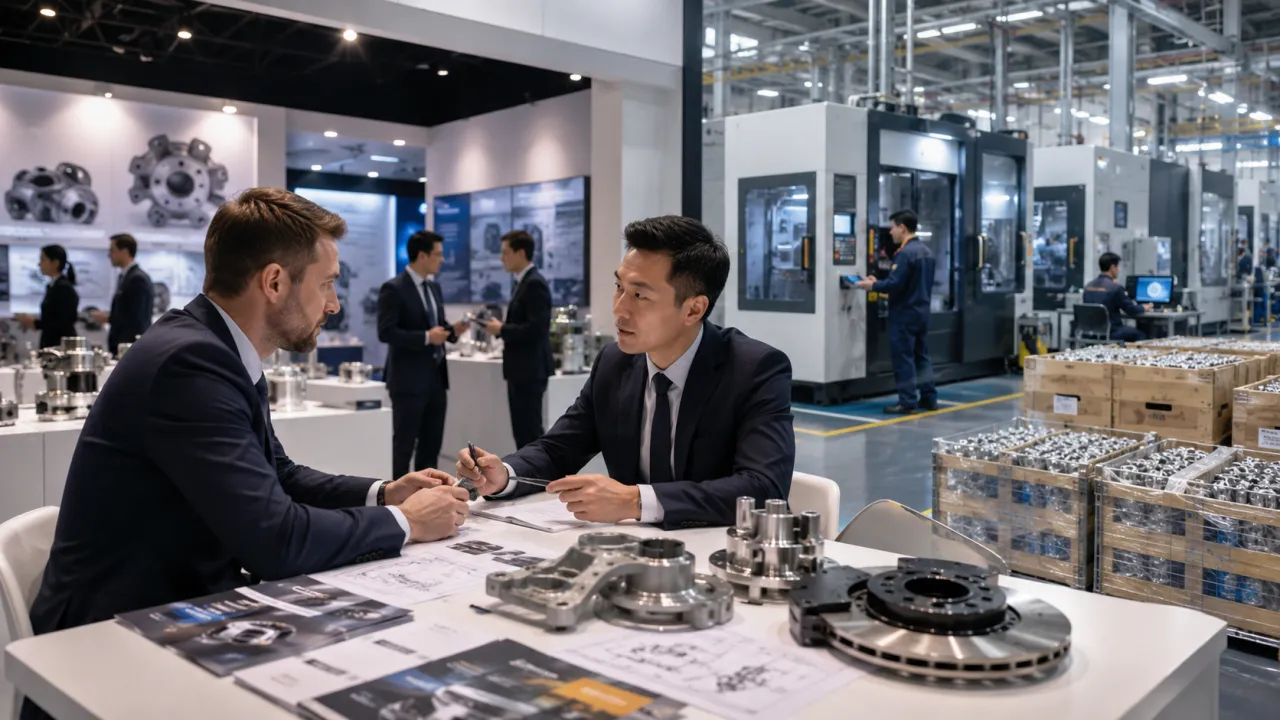
From Exhibition to Shipment—A Fast-Track That Works
B2B trade platforms give you access to thousands of ABS sensor listings, but they cannot replicate the speed at which a qualified supplier emerges from an exhibition meeting. At APES Shanghai and similar fairs, we have tracked buyer exhibitor interactions that move from handshake to PPAP submission in under sixty days—possible because the production engineer, certification documents, and first samples are all present in one room. If your team plans to source ABS sensors in the coming quarter, identify the nearest fair and request the early-bird exhibitor list. Send your part number and target annual volume to apeschina@huamogroup.com or call +021-60280788; we will help you align with the exhibition segment and industrial cluster that match your technical requirements.
Common Questions About Sourcing ABS Sensors at China Exhibitions
Do manufacturers offer genuine factory pricing at exhibition booths?
Yes, when you commit to a trial order volume during the show. Exhibitors often work with exhibition-specific pricing because they are pitching against neighboring stands and the cost of an unsold booth slot is high. State your first-year projected quantity and ask for an FOB Shanghai price that stays firm for 90 days; most medium-sized sensor factories will lock it if they see a repeat order path.
How can I spot a trader masquerading as an ABS sensor factory at a trade fair?
Check the company’s business registration scope on a Chinese business database—a genuine manufacturer will list “制造” (manufacturing) prominently and have a registered factory address in an industrial zone, not a downtown office. At the booth, ask to see an in-house magnetic encoder ring winding machine or test jig; a trader will deflect, a manufacturer will show you a video or invite you to the factory that afternoon.
What quality certifications should a wheel speed sensor supplier hold at minimum?
ISO 9001 is baseline and expected. For any sensor sold into OE service or safety-related applications, demand IATF 16949 certification from a recognized body like TÜV or SGS, and confirm that the certificate scope specifically includes “sensor” or “electronic component manufacturing.” If the application is for aftermarket distribution only, ISO 9001 plus a current E-mark or SAE test report for the part number may suffice, but always verify the test report against the sample at the booth.
Do I need a visa to attend automotive trade shows in China, and how early should I apply?
Most nationalities require a business visa (M) or a tourist visa (L) for exhibition attendance. The organizer’s invitation letter, which you receive after registering as a buyer, is generally sufficient for the M visa application. Apply at least four weeks ahead, and carry the printed invitation and hotel booking to the consulate appointment. Our team assists registered buyers with the documentation timeline; share your intended travel dates and we will confirm the visa support procedure.
Is it better to source ABS sensors from a dedicated sensor manufacturer or a full-line brake system supplier?
It depends on your integration requirements. If you need a sensor that mates with a specific wheel bearing and encoder ring set, a brake system supplier with in-house sensor design often gives better system-level compatibility. If you are replacing a standard-fit sensor with a like-for-like part, a specialist ABS sensor manufacturer usually offers better per-unit cost and a tighter sensor performance tolerance. In programs we’ve supported, buyers sourcing standalone sensors for aftermarket kits have had the highest first-pass yield from specialist sensor makers in Rui’an and Yuhuan. Share your target application and I will point you toward the right exhibitor category.
If you’re interested, check out these related articles:
Tomorrow World: Innovation Achievement Exhibition and Industry Future Forum
APES 2026 to Redefine Global Sourcing Landscape as Automotive Industry Eyes Resilient Future