
For buyers sourcing car body panel manufacturers, a China expo like APES Auto Parts Expo Shanghai offers a rare opportunity to meet dozens of suppliers face-to-face in one trip. But simply walking the aisles and collecting brochures rarely leads to good partnerships. Over a decade in exhibition marketing, I’ve seen that the buyers who come away with real suppliers are the ones who ask pointed, technically grounded questions. This article outlines exactly what to ask and observe to identify reliable body panel manufacturers at a China expo, separating genuine factories from resellers.
Why a China Expo Beats Online Sourcing for Body Panels
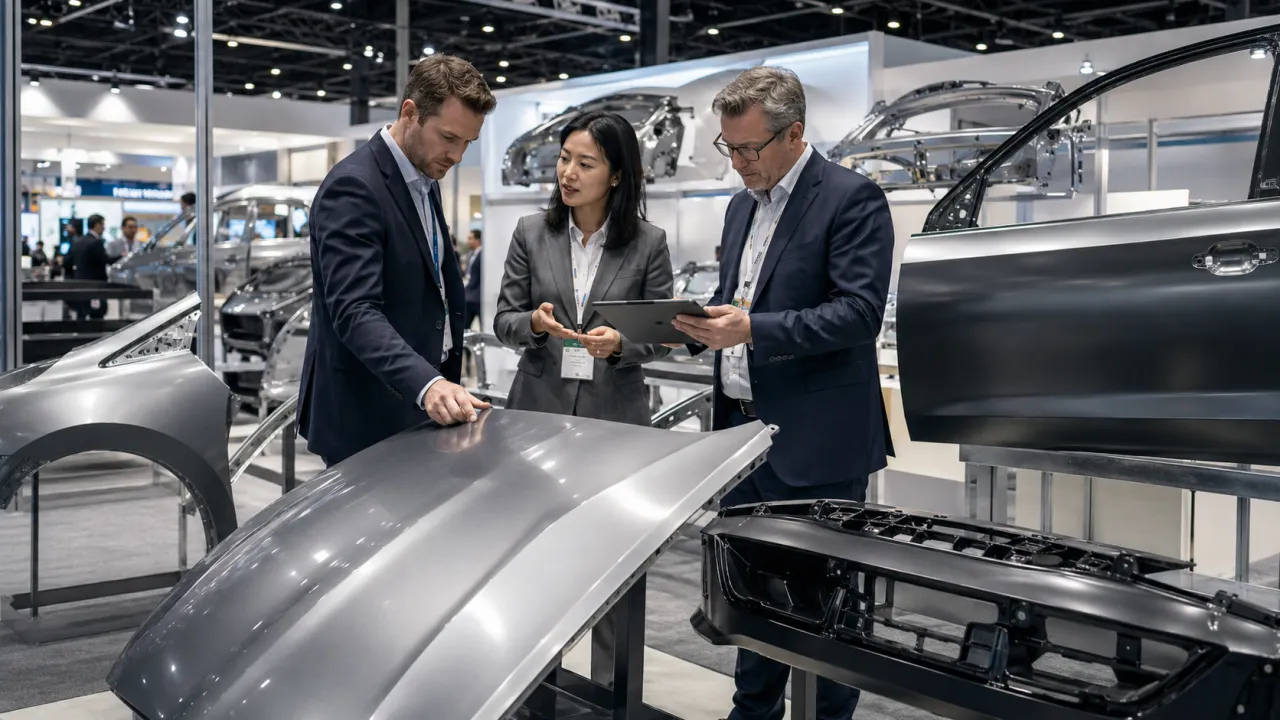
Trade shows collapse the typical months-long supplier search into a few days. Online catalogs show the same polished photos and claim every factory is “professional” and “certified.” In person, you can see the panel finish, ask about tooling origins, and gauge whether the sales team understands stamping die maintenance—all before spending anything on samples. Expos organized around industrial cluster logic, like APES in Shanghai, further concentrate production hubs so you can compare Jiangsu, Zhejiang, and Hebei manufacturers within the same hall. This proximity accelerates your shortlist because the differences in quality and response become obvious fast.
Pre-Show Preparation: What to Do Before You Land
Arriving without a clear plan wastes time. First, define your technical requirements precisely: material spec (cold-rolled steel, aluminum alloy, or composite), surface finish (E-coat only, or full paint-ready), expected annual volume, and packaging constraints. Second, pull the exhibitor list from the show’s official platform and filter by the “body parts” or “stamping” category. Ignore companies that only list “auto parts exporter” with no range; serious stampers list panel types—fenders, doors, hoods, bumpers—by vehicle segment. Third, compile a one-page technical brief that includes a single representative panel drawing with tolerance zones. Hand this to each candidate at the booth and watch their reaction. Manufacturers ask about press tonnage, die material, and batch sizes. Trading companies ask about color and box quantity.
If your program involves multiple panel types across different vehicle platforms, it is worth confirming each supplier’s ability to manage mixed-tooling production before you travel—reach out at apeschina@huamogroup.com or +021-60280788 and we can help you shortlist suitable exhibitors in advance.
On the Floor: 15-Minute Evaluation That Reveals Production Reality
A booth’s appearance tells you nothing about stamping capability. Spend your minutes on three verifiable indicators.
First, look at the physical sample panels on display. Run your finger along the hemmed edge of a door or hood. Consistent flange width with no visible wrinkling means the die design and press parameter control are mature. Any sharp burr or uneven gap suggests poor die maintenance or worn tooling.
Second, ask where the stamping dies were made. Manufacturers that own a tool shop or partner with a known Chinese die maker (many are in Taizhou or Dongguan) typically control quality better than those that outsource to the lowest bidder. Request the die steel grade—DC53, SKD11, or Cr12MoV are standard for medium to high volume panel production; lower grades lead to rapid wear and dimensional drift.
Third, ask about inline measurement. If the booth has even one panel with a CMM report or a laser scan deviation chart attached, that factory commits to data. If the salesperson cannot produce any dimensional report for a displayed panel, you are dealing with a trading company or a factory that ships by eye.
| Verification Point | Factory Signal | Trading Company Signal |
|---|---|---|
| Sample panel edge quality | Consistent, no burrs | Rough, sharp, or uneven |
| Answer about die origin | Names a tool shop or die steel grade | “We have our own factory; it’s fine” |
| In-booth measurement report | Shows CMM data or scan overlay | No measurement document available |
Five Questions That Separate Real Panel Manufacturers from Resellers
- “What is your largest single press tonnage on the stamping line?” Body panels, especially roof panels and door outer skins, require high tonnage. A factory running at least a 1000-ton mechanical press can handle most passenger car outer panels. If they only have 400-ton presses, they are likely limited to small brackets and inner reinforcements.
- “Can you provide PPAP Level 3 documentation for a previous panel project?” Manufacturers that supply Tier 1 or aftermarket programs routinely prepare Production Part Approval Process files. A trading company stalls or says “we can get it later.” Pay attention to the hesitation.
- “How do you prevent springback distortion on aluminum body panels?” Aluminum panels present specific forming challenges. A real stamper talks about die compensation, blank holder force adjustment, and sometimes warm forming. A reseller gives a generic answer about quality control.
- “Can you arrange a line visit during the show week?” Factories that exhibit at a major Shanghai expo often prepare a shuttle bus to their plant (many clusters are within a three-hour radius). If they decline or offer only an office tour, they are hiding something.
- “Which export markets do you currently ship to, and do you have any customer panel acceptance rate data?” Instead of asking for a client list (confidential), ask for aggregated quality metrics. A manufacturer knows its 3-month or 6-month reject rate. A reseller deflects.
After the Expo: Turning Booth Conversations into Supply Partners
Collect technical notes and panel photos from each booth and rate candidates within 48 hours while the impression is fresh. Send a follow-up email that includes the part number you discussed and a request for a formal quotation with tooling cost, piece price at three volume breakpoints, lead time, and packaging spec. Request at least three sample panels with full dimensional reports. Use the show connection to move quickly: suppliers who met you in person are far more responsive than those reached cold online. If a factory pushes sample costs without offering any technical discussion, deprioritize it—serious manufacturers understand that samples are an investment toward a supply contract.
Common Questions About Sourcing Body Panels at China Expos
Are the body panel samples at an expo booth representative of production quality?
Often yes, but only if you verify. Exhibitors bring their best samples, so ask for a random production-run panel. A manufacturer confident in its process will agree to ship a recent production sample after the show. If they only offer the same polished booth piece, treat it as a red flag.
What if I can’t tell a real factory from a trading company even after asking these questions?
Look for three hard signals: in-house tooling capability, at least one dedicated quality engineer present at the booth who can discuss failure modes, and an immediate willingness to show a line tour. If all three are absent, walk away regardless of price.
Should I negotiate price at the expo?
Start the price conversation only after you establish technical compatibility. A few percentage points of discount mean nothing if the panel fails dimensional checks later. Focus on total landed cost including tooling amortization, and use the show to compare the same drawing across three suppliers.
Is it worth visiting an expo if I only need low-volume body panels?
Yes, and be upfront about your volume. Some manufacturers specialize in low-volume aftermarket panels and will quote accordingly. Others run high-volume OEM lines and will decline politely. The show lets you find the fit fast. Share your requirements and we’ll confirm which exhibitors match your volume profile.
If you’re interested, check out these related articles:
APES 2026 to Redefine Global Sourcing Landscape as Automotive Industry Eyes Resilient Future
Tomorrow World: Innovation Achievement Exhibition and Industry Future Forum