
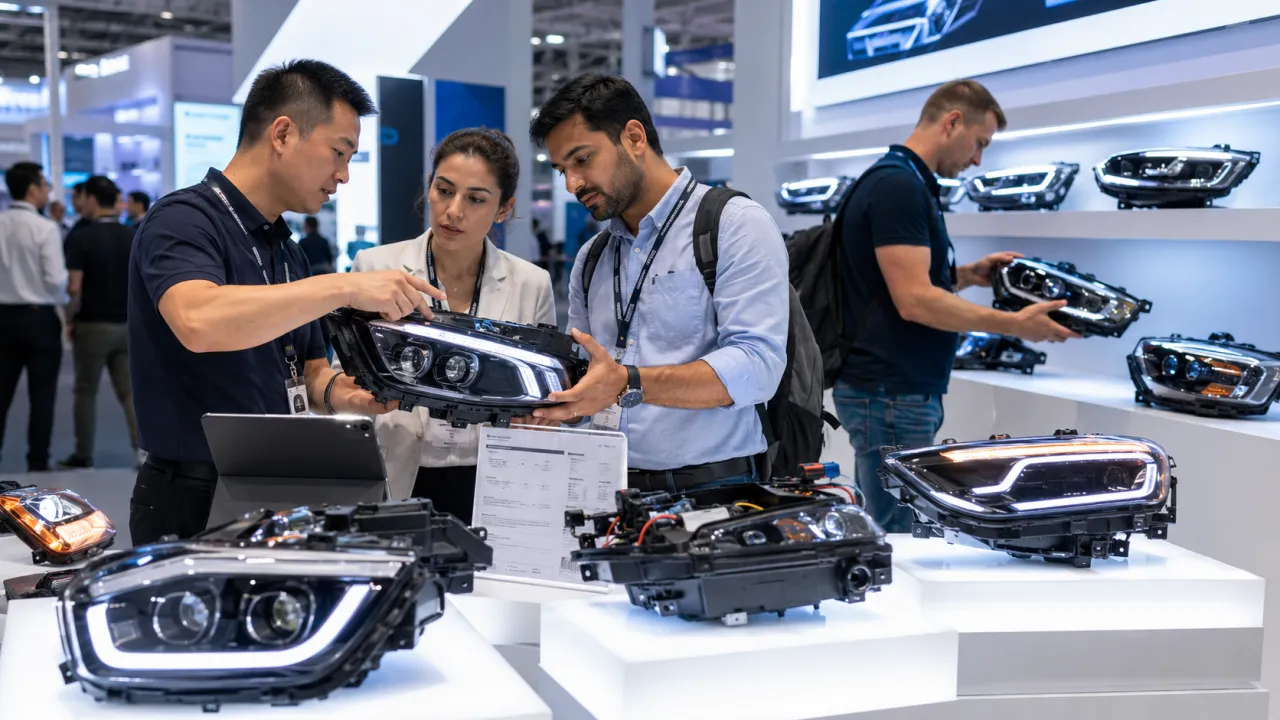
Sourcing auto headlights directly from manufacturers is one of the most margin-sensitive decisions a procurement team can make. After over a decade of organizing automotive trade fairs and observing how global buyers connect with Chinese suppliers, I have seen that the quality of the match depends less on finding any supplier and more on knowing where to look and what to ask. A China auto headlight trade show that brings together verified manufacturers from key industrial clusters gives you a concentrated environment to compare products, negotiate terms, and verify production capability—all within a few days.
Why a Trade Show Outperforms Online Sourcing for Headlight Buyers
Online platforms give you a long list of suppliers. A professional auto parts exhibition gives you the supplier’s factory story, not just a product image. That difference matters when you are sourcing safety-critical components like headlights, where beam pattern consistency, material grade, and thermal management can’t be assessed from a PDF.
At a dedicated trade show, you walk a floor organized by product category and manufacturing region. Rather than scrolling through hundreds of online profiles, you see headlight samples side by side, under uniform lighting, and you can question the engineer who designed the optics. The concentration of expertise is something no B2B platform replicates.
| Sourcing Channel | Product Evaluation | Supplier Verification | Negotiation Speed |
|---|---|---|---|
| Trade Show | Physical samples, live light testing | On-the-spot certification review, factory video walkthrough | Direct, face-to-face, often within hours |
| B2B Online Platform | Photos & spec sheets only | Relies on uploaded documents, third-party audits optional | Days to weeks of back-and-forth messaging |
| Factory Visit Alone | Excellent for one supplier | Deep for that factory | 2–3 days per supplier including travel |
A show compresses this timeline. You can evaluate five to eight headlight manufacturers in a single day, compare their approaches to LED module design or lens coating, and leave with a shortlist grounded in personal observation.
Changzhou and Beyond: Understanding China’s Headlight Manufacturing Clusters
Auto headlight production in China is not scattered randomly. It concentrates in specific industrial clusters, each with decades of specialization that shapes the capabilities and cost structures you encounter.
Changzhou, in Jiangsu province, is the most recognized automotive lighting cluster. The city and its satellite towns host hundreds of manufacturers focused on headlights, tail lights, and fog lamps covering everything from economy halogen units to advanced LED matrix systems. Visiting a trade show where Changzhou-based suppliers exhibit gives you access to multiple factories in one day, something that would take a week to achieve through individual factory visits.
Other clusters also matter. Wenzhou and Ruian are strong in electronic control modules used in adaptive lighting. Yuhuan supplies a significant share of headlight brackets and mounting hardware. When a trade show draws exhibitors from these clusters, you can assemble a complete headlight supply chain without traveling across the country.
A well-structured exhibition like the APES Auto Parts Expo Shanghai maps its hall layout around these clusters, so you can plan a walking route that covers Changzhou lighting suppliers in the morning and electronics specialists in the afternoon.
Vetting a Headlight Supplier at a Trade Show: The Questions That Matter
A trade show booth is a controlled environment. The samples are polished, the sales team is rehearsed. Your job is to ask questions that distinguish a factory with genuine engineering depth from a trading company that purchases from third parties and resells.
Start with certification and compliance. Ask for the IATF 16949 certificate number and the issuing body. In my experience, a factory that hesitates or cannot name the certification body on the spot often holds only a basic ISO 9001, which is insufficient for automotive OEM-grade headlights.
Then move to product and process specifics. Five questions that separate capable manufacturers from intermediaries:
- What is your in-house surface treatment process for the reflector? A factory that subcontracts reflector coating loses control over beam pattern precision.
- Can I see your heat dissipation test data for this LED model? LED headlights fail early without proper thermal management. The test report should be available at the booth.
- Who supplies your PC lens material? If the answer is an internationally recognized polymer supplier, you have a point of traceability.
- What is your typical sample lead time for a new housing design? Expect 15–25 working days for a new mold. Longer lead times often mean moldmaking is outsourced.
- Which export markets do you regularly ship to? A supplier that already exports to Germany, Japan, or North America has been through stricter homologation processes. This cross-validates their quality management.
| Red Flag | What It Signals |
|---|---|
| Cannot show factory video on request | No manufacturing facility, or not the one producing the samples |
| Quoting FOB price with no MOQ inquiry | Trading company mentality, not a factory |
| “We can produce anything” without a product category focus | No specialization, likely sourcing from multiple sub-suppliers |
| Refuses to share a recent export bill of lading | Potentially no real export history |
A trade show lets you spot these signals quickly because you can observe booth staff, examine sample build quality under your own magnifier, and compare answers across multiple suppliers within an hour.
Samples, Factory Visits, and PO: Moving from Introduction to Order
The real value of meeting a headlight supplier at a trade show materializes after the event. I always advise buyers to request a factory visit for their top three candidates before the booth encounter ends.
Most factories exhibiting at a China auto parts show expect booth conversations to lead to factory inspections. If the show is in Shanghai, many Changzhou manufacturers will arrange a car pick-up the following day to bring you to their production line. The factory visit reveals what the trade show booth cannot: the condition of the injection molding workshop, the dust-free standards in the assembly area, and whether the engineering team can discuss a drawing revision confidently.
Once you have visited the factory, move to samples quickly. Specify exactly the housing design, light source configuration, and certification requirements you need. Agree on sample costs and delivery terms while both parties are clear on the technical discussion. A recommendation that has served our exhibition participants well: ask for two identical sample sets—one for photometric testing and one as a reference sample kept sealed. If the tested sample fails a specification, the sealed partner sample becomes your evidence for the discrepancy discussion.
Post-show communication should be direct. Within three working days, confirm your evaluation timeline and the next step. A supplier that was serious at the booth will respond to a detailed follow-up within 24 hours.
Preparing Your Visit: A Headlight Sourcing Checklist
A productive trade show visit starts before you land in China. From working with hundreds of international buyers at automotive exhibitions, here is a checklist that separates prepared sourcing managers from overwhelmed first-time visitors.
- Define your technical specification in a one-page brief. Include beam pattern requirement (ECE or SAE), color temperature range, operating voltage, connector type, and relevant compliance standards (UNECE R149, FMVSS 108). Share this brief with shortlisted suppliers before the show.
- Book your badge and travel early. Major shows in Shanghai like APES attract 35,000+ professional buyers. Registration queues on the first morning can cost you two hours of booth time.
- Bring a luminance meter and a magnifying loupe. A luminance meter lets you check light intensity consistency. A loupe reveals mold lines and material quality that the naked eye misses.
- Plan your booth route around industrial clusters. If the exhibition floor plan is available, mark the booths from Changzhou lighting manufacturers, Wenzhou electronics specialists, and other relevant clusters. Walk the route the day before if possible.
- Carry a translator or use a reliable translation app with offline capability. While many export-oriented factory managers speak English, technical discussions about optics or materials often default to Mandarin for precision.
The investment in preparation pays off when you walk into the first booth already knowing the right product code, the target market certification, and the questions that will separate serious factories from general traders.
Turning Trade Show Connections into a Reliable Supply Line
Securing a qualified headlight supplier at a China trade show is not about collecting the most business cards. It is about identifying two or three factories with the technical capability, export experience, and communication clarity to become long-term partners.
In programs we have supported through the APES platform, buyers who combined a structured booth evaluation with a next-day factory visit reduced their supplier qualification cycle by 50% compared to sourcing exclusively online. The cost of the trip is recovered within the first container order that avoids quality surprises.
If you are planning a headlight sourcing trip or want to understand which Changzhou and Wenzhou lighting manufacturers are exhibiting at the next APES Auto Parts Expo Shanghai, share your product specifications and preferred timeline with us at apeschina@huamogroup.com or call +021-60280788. We will connect you with the relevant exhibitor category and help structure your visit for maximum outcomes.
What Procurement Teams Frequently Ask About China Headlight Trade Shows
We have never sourced headlights from China. Are the quality standards high enough for aftermarket or OEM?
The capability covers both. Chinese headlight manufacturers that regularly export to Europe and North America operate under the same UNECE and SAE standards your target market requires. The key is to focus on factories that already hold IATF 16949 certification and can name their recent export destinations. A trade show makes this filtering efficient: you can check the certificate in the booth and request an export reference within the same conversation. If the response is vague, move to the next booth.
What is the advantage of meeting suppliers at a trade show versus visiting factories directly?
A trade show compresses geography into hours. Changzhou, Wenzhou, and Yuhuan are spread across three different provinces. Visiting each factory individually would take a week of travel, excluding production delays and traffic. A well-organized exhibition brings compliant manufacturers from all three clusters into one venue. You compare products under similar conditions, benchmark pricing, and assess company professionalism across multiple suppliers in a single day.
How do I avoid trading companies that position themselves as factories?
Inspection of physical samples helps, but the conversation reveals more. A genuine factory salesperson can discuss injection mold cycle times, PC lens supplier names, and testing equipment models from memory. A trading company representative will need to “check with the factory” for every technical question. At a trade show, you can also ask to see a short factory video on the spot—most real manufacturers have one ready on their phone.
Is it worth visiting a trade show if I only need one headlight model in medium volume?
Yes, if the volume is consistent. A medium-volume order of 3,000 to 10,000 units per year is commercially interesting to many specialized manufacturers, especially if the design is stable and the forecast is reliable. At a trade show, you can negotiate directly with decision-makers who have the authority to accept such volumes without routing through layers of sales hierarchy. If your program involves specific homologation requirements for your target market, it is worth confirming the supplier’s homologation support experience before committing. Send your requirements to apeschina@huamogroup.com and we will help identify exhibitors who match your order profile.
If you’re interested, check out these related articles:
APES 2026 to Redefine Global Sourcing Landscape as Automotive Industry Eyes Resilient Future
Tomorrow World: Innovation Achievement Exhibition and Industry Future Forum