
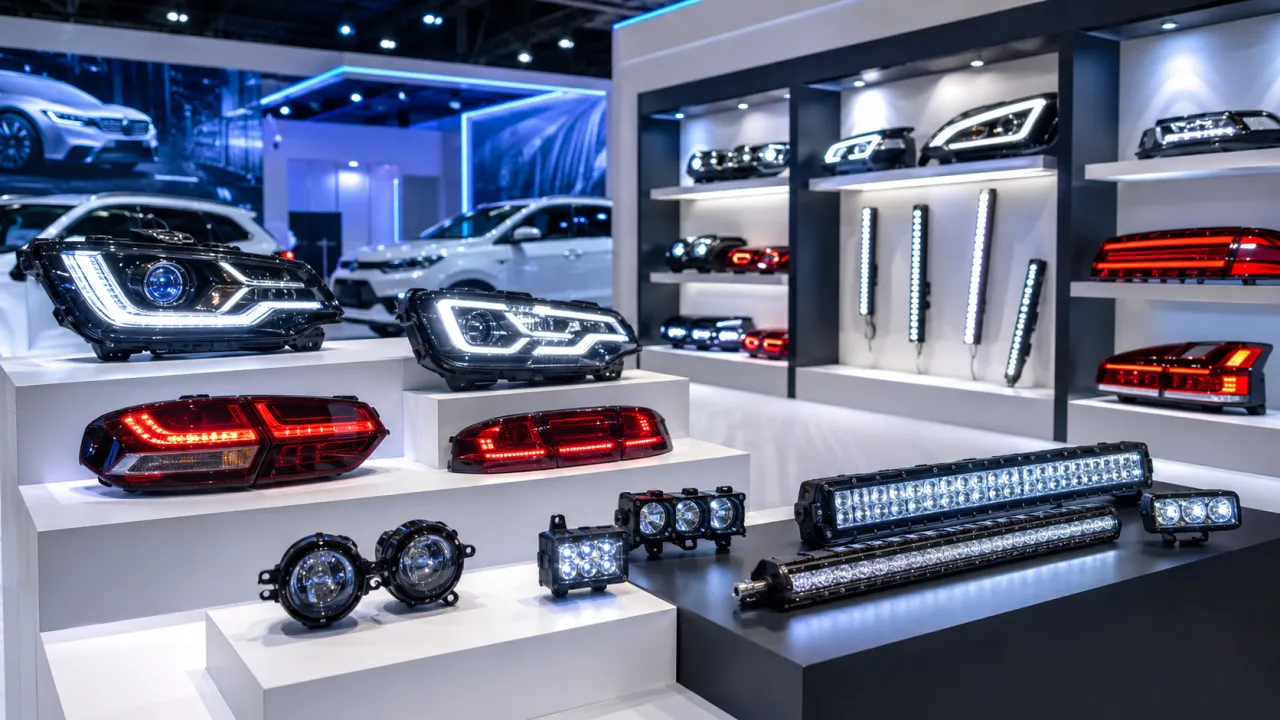
For procurement professionals sourcing automotive lighting, China remains the world’s largest manufacturing base for LED car lights. The most efficient path to find qualified LED car light manufacturers is rarely through endless online searches. A dedicated LED car light manufacturer China exhibition puts factory owners, engineers, and export managers in one hall, letting you compare products, certifications, and production capability side by side in a single trip. Having organized automotive trade events for over a decade, I’ve seen how the right exhibition can cut supplier vetting from months to days—if you know what to look for and which questions to ask before you commit.
Why a China Exhibition Beats Online Sourcing for LED Car Lights
Digital sourcing platforms give you a catalog; a trade exhibition gives you the factory. When you walk an exhibition floor targeting automotive lighting, you can inspect beam patterns, housing material quality, and thermal management first-hand. More important, you can ask production-line questions that simply don’t get answered through a chat window—lead times, tooling ownership, and real customization capability.
China’s automotive lighting industry is concentrated in specific manufacturing clusters. Instead of hopping between scattered suppliers across provinces, a well-organized exhibition brings the cluster to you. Changzhou, for example, supplies a large share of the world’s aftermarket LED headlights, work lights, and auxiliary lamps. At a show like APES Auto Parts Expo Shanghai, you can meet manufacturers from that cluster and neighboring cities, many of whom operate their own mold shops, SMT assembly lines, and optical testing labs. That concentration cuts travel time and lets you benchmark five or six factories in one day using the same reference sample.
Separating Genuine LED Car Light Manufacturers from Traders
Trade shows attract both factory owners and trading companies. Telling them apart takes a handful of direct questions. A genuine LED car light manufacturer can show photos of their SMT line, injection molding floor, and quality lab—not just a showroom. Ask for the name of the production city and the factory address on the spot. If the person in the booth hesitates or gives a generic answer, you’re likely talking to a middleman.
Certification is another filter. For automotive lighting, IATF 16949 is the standard that signals an organization built around automotive quality systems. An ISO 9001 certificate alone does not tell you the same story. Manufacturers that ship to the European aftermarket also carry E-mark approvals; those serving North America typically have SAE/DOT test reports for specific part numbers. Requesting the certificate document during the meeting—rather than accepting a promise to email it later—saves follow-up time and quickly weeds out companies that rent the branding but not the capability.
Evaluating LED Car Light Quality on the Exhibition Floor
A booth illuminated by a manufacturer’s own products is the best test lab you will get without visiting the factory. Three practical checks matter most.
First, luminance uniformity and beam pattern. Ask to see a headlight or work light powered on against a whiteboard or the booth wall. A sharp cutoff line and even light distribution indicate optical design work, not just a bright assembly of LEDs. Second, heat dissipation design. Touch the housing of a demo unit that has been running for a while. If the aluminum body is barely warm, the thermal path is likely undersized or the LED board is under-driven to mask thermal sag. Third, material and sealing. Look at the gasket mating surfaces and connector seals. For IP67 or IP69K rated products, the cable entry should be potted or sealed with a mechanical gland, not a simple rubber grommet. Manufacturers that bring cutaway samples or cross-section displays to the booth are typically the ones that invest in engineering, not just assembly.
The Changzhou Advantage: China’s Auto Lighting Manufacturing Hub
Changzhou in Jiangsu province has built a deep supply chain around automotive lighting. The cluster covers everything from aluminum die-casting for housings to PC lens injection molding, SMT LED board assembly, and optical testing. Because so many processes co-locate, lead times shrink and design-for-manufacturing feedback happens in hours, not weeks.
The APES Auto Parts Expo Shanghai draws manufacturers from Changzhou, Wenzhou, and beyond, creating a dense sourcing environment for buyers who want factory-direct terms. Rather than dealing with three different intermediaries, you can sit with the technical team that owns the mold flow analysis and the photometric testing data. For procurement teams looking to shorten the chain, targeting an exhibition that actively organizes manufacturer participation by industrial cluster—rather than one that simply sells floor space to any exhibitor—is a practical advantage.
Making Your Exhibition Visit Count: Meetings, Samples, and Negotiations
The difference between a productive show and an exhausting walk-through often comes down to preparation. Before you arrive, mail your reference samples or 2D drawings to the manufacturers you intend to meet. Ask them to prepare a preliminary sample, BOM breakdown, or photometric test report so that the face-to-face time is spent on substantive discussion, not introductions.
During the meeting, confirm minimum order quantities by SKU, not just by container. Many LED lighting manufacturers will quote an attractive unit price at 2000 pieces but drop only 3% at 5000—your supplier selection may shift based on that spread. Discuss tooling amortization if you need a custom housing. Some manufacturers include tooling cost in the first order; others bill it separately and retain ownership. Those terms affect your long-term pricing and ability to move the mold later. Taking a written note on a simple meeting sheet—date, booth number, key agreements—saves confusion when reviewing ten suppliers four weeks later.
After the Exhibition: Securing LED Lighting Supply
The 48 hours after the show close are when your visit pays off or fades. Send a short email that references the specific product and pricing discussed, ideally with a photo of the sample you held, so the manufacturer can tie the conversation to the right design immediately. Request a formal quotation that includes payment terms, shipping terms, and lead time with a validity date.
If the product will be exported to regulated markets, ask for the lab test reports corresponding to the certification claims made at the booth. E-mark or SAE compliance should be verifiable by a report number, not just a logo on a brochure. For new tooling projects, schedule a factory visit within four weeks to confirm that the tool shop and assembly floor match what was presented at the exhibition. A quick site walk reveals whether the lines are actively producing volume or are dressed for visitors.
The exhibition gave you a shortlist. The post-show discipline turns the shortlist into a reliable supply chain.
Turning Your Exhibition Shortlist into a Reliable Supply Chain
Sorting through ten business cards and dozens of brochures after a China exhibition can feel overwhelming. The most effective buyers I work with filter by the factory visit principle: if the manufacturer agrees to an onsite audit within 30 days and has provided verifiable certification documents, they stay on the shortlist. Others drop. That single rule removes around half the candidates and focuses your time on the suppliers who invest in long-term partnerships rather than one-off deals.
An exhibition that conveniently gathers LED car light manufacturers from China’s core production clusters accelerates this process. The APES Auto Parts Expo Shanghai, held annually at the National Exhibition and Convention Center, brings together Changzhou lighting specialists, global buyers, and industry associations in a structured sourcing environment. To receive the updated exhibitor list and schedule meetings ahead of the show, email apeschina@huamogroup.com or call +021-60280788. Mention your target product category and volume range so the team can recommend the most relevant manufacturer pavilion.
Common Questions About Sourcing LED Car Lights at China Exhibitions
Are Chinese LED car light manufacturers capable of meeting international quality standards?
The top tier manufacturers certainly are. Many Changzhou LED lighting companies hold IATF 16949, E-mark, and SAE/DOT certifications and export directly to European and North American aftermarket distributors. The key is verifying that the certification covers the specific product line you are buying, not just the company name. At the exhibition, ask to see the certificate with a current audit date and match the product scope listed on the document with the sample in front of you.
What is the typical minimum order quantity when buying directly from a manufacturer?
MOQs vary by product complexity and whether tooling already exists. For standard LED auxiliary lamps, 500 to 1000 units per SKU is common; custom housings often require 2000 units or more to absorb tooling amortization. Factories in Changzhou tend to be flexible with sample orders for first-time buyers attending an exhibition, so negotiate a small trial batch before committing to volume production.
Can I get OEM branding and custom packaging at an exhibition order?
Yes, OEM and ODM capabilities are widely available. At the booth, specify whether you need silk-screen printing, laser engraving, or custom injection-molded housings with your brand. Experienced manufacturers will show you previous OEM projects and discuss tooling timelines immediately. The exhibition setting allows you to evaluate their design engineering team face-to-face, which is far more reliable than email-only communication.
Should I expect to place an order during the exhibition?
It is wise to collect quotations, samples, and certification documents during the show, then finalize the order after you have cross-checked your shortlist at home. Rushed orders signed on the exhibition floor sometimes carry pricing or specification gaps that are costly to correct later. A professional buyer uses the event for qualification and relationship building, with the purchase order following within two to four weeks after the factory visit if possible.
What is the best way to find authenticated LED car light manufacturers at a China exhibition?
Look for exhibitions that pre-screen exhibitors by production capability and factory location, not just by booth payment. The APES Auto Parts Expo Shanghai is organized specifically to connect global buyers with verified manufacturers from China’s auto parts industrial clusters, including Changzhou’s lighting sector. If you want to receive the upcoming exhibition schedule and a curated list of LED lighting exhibitors matching your product requirements, email apeschina@huamogroup.com with your product category and quantity expectations.
If you’re interested, check out these related articles:
APES 2026 to Redefine Global Sourcing Landscape as Automotive Industry Eyes Resilient Future
Tomorrow World: Innovation Achievement Exhibition and Industry Future Forum