
For international buyers seeking automotive lighting products without intermediary markups, Shanghai’s trade exhibitions offer a focused opportunity to meet factory-level suppliers face-to-face. Events like the APES Auto Parts Expo bring together hundreds of manufacturers from China’s leading industrial clusters—especially the Changzhou lighting zone—displaying everything from mass-market LED headlights to OE-grade adaptive modules. In ten years of connecting global buyers with Chinese automotive lighting manufacturers, I have seen a well-planned exhibition visit consistently deliver faster, more reliable outcomes than months of online sample negotiations. This guide sets out what product categories you can expect, how to assess suppliers on the show floor, and the practical steps to turn a Shanghai exhibition trip into a real sourcing pipeline.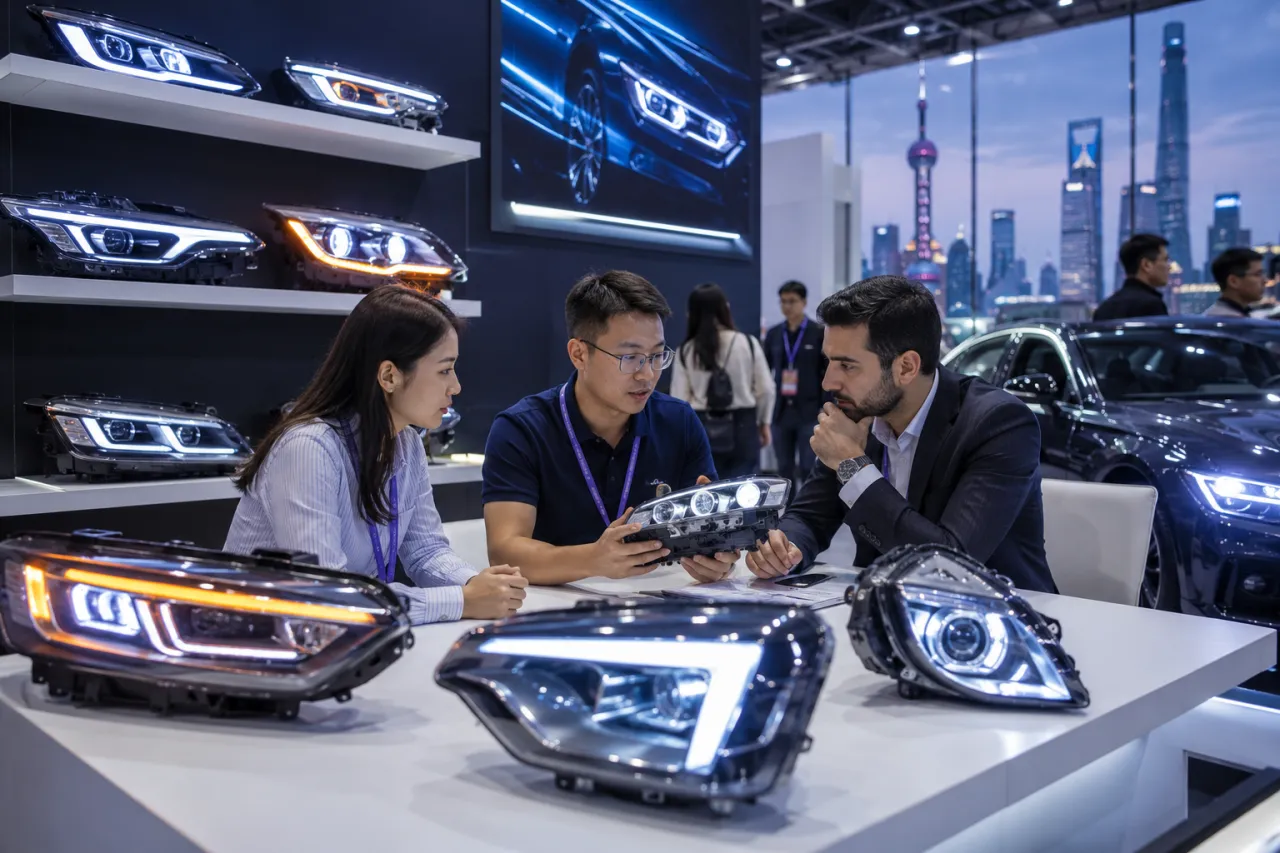
Why Shanghai Exhibitions Are a Strategic Gateway for Automotive Lighting Sourcing
Shanghai’s position as Asia’s largest trade fair hub gives automotive lighting buyers direct access to China’s entire supply chain in one city. The concentration of domestic manufacturers—from tier-one OEM suppliers to specialized aftermarket producers—means you can compare multiple factories’ capabilities within a few exhibition halls rather than traveling across provinces. For lighting specifically, this matters because product specifications vary widely: beam patterns, luminous flux, heat dissipation design, connector compatibility, and compliance certifications all decide whether a component fits your market. Seeing and testing products in person eliminates the guesswork that comes with catalog photos and spec sheets alone.
The Changzhou cluster, just upstream from Shanghai, is the single largest automotive lighting manufacturing base in China, accounting for a significant share of the country’s headlight and taillight output. When this cluster exhibits in Shanghai, buyers can evaluate dozens of factories from the same industrial ecosystem—often sharing similar production capabilities yet differentiated by specialization in halogen assemblies, LED modules, or adaptive beam systems. I’ve observed that buyers who schedule meetings with Changzhou exhibitors in advance routinely walk away with concrete quotations, not just brochures, because these manufacturers come to the show ready to negotiate volume and delivery timelines.
The Changzhou Lighting Cluster Advantage
What sets Changzhou apart is not just scale but supply chain integration. A single headlight assembly involves injection molds, reflectors, lenses, wiring harnesses, and electronic drivers—often sourced from nearby sub-suppliers within a 50-kilometer radius. Exhibiting at a Shanghai show, a Changzhou manufacturer can present the full integrated product rather than isolated components. For buyers, this means one face-to-face discussion can clarify lead times for a complete lighting system, including tooling modifications if required. This depth is difficult to replicate through online sourcing portals where component-level traceability breaks down.
What Automotive Lighting Products You Can Source at Shanghai Expos
The product range spans both replacement aftermarket and original equipment categories. On the exhibition floor, you will typically encounter:
Exterior lighting: complete headlight and taillight assemblies for passenger vehicles and commercial trucks; separate components such as bulbs, lenses, and reflectors; fog lamps and daytime running lights.
Interior and signal lighting: ambient interior modules, instrument panel backlights, turn signal units, and side marker lights.
Advanced systems: LED matrix headlights, adaptive driving beam (ADB) modules, and laser-based high-beam units—though these are still predominantly shown by larger tier-one exhibitors.
Associated electronics: LED drivers, thermal management substrates, and wiring connectors specifically rated for automotive voltage and temperature ranges.
Many exhibitors will show both off-the-shelf catalog products and examples of their custom OEM/ODM work. If your program requires specific beam certifications (E-mark, SAE, CCC) or material standards such as IATF 16949, verify these on the booth. Do not assume all products meet all regional regulations—ask for the compliance documentation directly at the show.
| Product Category | Typical Availability | Key Certification to Verify |
|---|---|---|
| Aftermarket LED headlights | Wide, many exhibitors | E-mark for European markets |
| OE-grade projector modules | Moderate, selected tier-ones | IATF 16949, OEM PPAP |
| Complete taillight assemblies | Wide | SAE or CCC depending on region |
| Adaptive beam systems | Limited, large manufacturers only | ECE R123 for UN markets |
| Interior ambient lighting | Wide, many electronics exhibitors | Automotive temperature rating |
If your sourcing requirements include both aftermarket and OE-grade lighting with full compliance documentation, it is worth confirming which exhibitors carry valid certifications before you finalize your shortlist—reach out at apeschina@huamogroup.com and we can pre-screen participating manufacturers.
How to Evaluate Automotive Lighting Suppliers on the Exhibition Floor
A supplier’s booth presentation tells you something, but not everything. I recommend a structured evaluation that goes beyond the sample display:
Request a live illumination demonstration. Ask to see the headlight or taillight powered up; check for uniform beam pattern, color temperature consistency, and audible noise from cooling fans. A sample that fails to light during the show, or one with obvious hot spots, often indicates inconsistent production quality rather than a single defective unit.
Inspect the physical build quality. Examine lens clarity, gasket sealing, connector fit, and housing material. Look for mold flash on plastic parts or inconsistent gap lines—these are telltale signs of lower-tier tooling. For LED units, ask about the chip source (e.g., Lumileds, Osram, or domestic brands) and whether the driver is integrated or external. The answers tell you whether the factory designs or simply assembles.
Discuss the production process, not just the product. Inquire about injection molding machine tonnage, aluminum PCB substrate specifications, and test equipment (goniophotometer, integrating sphere, thermal shock chamber). When a sales representative cannot explain their quality control steps beyond “100% inspection,” that is information too.
Get a written quotation on the spot. A serious factory exhibitor will have cost breakdowns for different order volumes, tooling amortization, and delivery terms available. If they promise to email later and never do, you have learned something about how they manage commitments.
One of the most important checks is whether the supplier is already shipping to your target region with valid homologation. Ask to see a recent test report from a recognized lab—not a self-declaration.
On-Booth Inspection Checklist
- Live illumination: uniform beam, correct color temperature
- Lens and housing: no flashing, smooth seals
- Connector: secure fit, standard pin assignment
- Certifications: request paper copies of E-mark, SAE, or CCC as applicable
- Production depth: ask about mold ownership and PCB sourcing
- References: request contact information for an existing overseas customer in a non-competing territory
Maximizing Your Exhibition Sourcing ROI
The difference between a productive exhibition visit and an expensive walkthrough often comes down to pre-show planning. I advise buyers to treat a Shanghai automotive lighting exhibition as a concentrated sourcing operation, not a casual discovery trip.
Begin by building a target list of exhibitors based on product category, certifications, and previous export experience. The exhibition organizer’s online catalog typically includes exhibitor profiles, product categories, and contact information. Reach out to selected manufacturers two to three weeks before the show to schedule 30-minute meetings at their booth. In my experience, exhibitors are far more prepared when they know a serious buyer is coming—they will have English-speaking staff available, test samples powered up, and preliminary pricing ready.
During the show, allocate mornings for scheduled supplier meetings when energy and booth staff are fresh, and afternoons for walking the halls to discover new exhibitors you may have missed. Carry a portable power bank and a notebook—you will take far more notes and photos than you expect. After each meeting, immediately record your impressions and any agreed action items while memory is fresh. A simple rating system for product quality, factory capability, communication, and pricing consistency will help you compare candidates after the show when details start to blur.
Leveraging Organizer Matchmaking Services
Many exhibition organizers, including APES, run structured buyer-supplier matchmaking programs that pre-arrange meetings based on your sourcing profile. This service costs nothing for qualified buyers and often surfaces manufacturers you would not find through the public exhibitor list alone. Specify your product categories clearly—for example, “ECE-approved LED headlight assemblies for commercial vehicles, 12V and 24V”—so the matchmaking algorithm identifies relevant factories rather than general lighting suppliers.
Taking the Next Step: Planning Your Exhibition Visit
The next major automotive parts exhibition in Shanghai that features a dedicated lighting sector is scheduled for mid-2026 at the National Exhibition and Convention Center (NECC) in Hongqiao. International visitors typically require a business visa supported by an invitation letter from the exhibition organizer, which is standard for registered buyers. Plan to apply at least four to six weeks in advance, as visa processing times vary by country.
When you arrive, the exhibition complex is directly connected to Shanghai Hongqiao Railway Station and the metro network, with numerous hotels within a 30-minute radius. Most exhibitors will have English-language catalogs, though having a translation app for technical discussions with factory engineers is practical. Payment terms, shipping arrangements, and quality inspection protocols are best negotiated face-to-face at the exhibition rather than over email afterward.
Sourcing automotive lighting through a Shanghai exhibition puts you in direct contact with manufacturers who can supply both high-volume aftermarket products and precision OEM assemblies. The advantage over online platforms is immediate: you assess build quality with your own hands, negotiate terms person-to-person, and establish the kind of supplier relationship that supports long-term supply chain reliability. To begin planning your visit or to explore exhibiting opportunities at the next APES Auto Parts Expo, share your lighting product requirements and target volumes with our team. Email apeschina@huamogroup.com or call +021-60280788. Our buyer matchmaking service connects you directly with factories that match your technical, certification, and volume needs—cutting through the noise of a large exhibition to the suppliers that matter for your market.
Common Questions About Sourcing Automotive Lighting at Shanghai Exhibitions
When is the next automotive lighting exhibition in Shanghai?
The next APES Auto Parts Expo, which includes a comprehensive automotive lighting sector, is scheduled for July 2026 at the NECC Hongqiao. This exhibition brings together manufacturers from across China, with a significant presence from the Changzhou lighting cluster. Exact dates are published on the organizer’s website approximately six months before the event. International buyers should plan to register early to receive invitation letters for visa processing.
Can I get factory-level pricing at a lighting exhibition?
Yes—and in many cases, exhibition-floor pricing is more competitive than what you will obtain through online inquiry channels. Exhibitors typically come to the show ready to close deals and offer volume-based discounts for orders placed during or shortly after the exhibition. Having a clear specification sheet and target annual volume when you walk into the booth puts you in a strong negotiating position. If you need a ballpark FOB Shanghai price for an LED taillight assembly with specific homologation requirements, share your part number and expected quantity at apeschina@huamogroup.com and we can connect you with qualifying exhibitors before you travel.
If you’re interested, check out these related articles:
APES 2026 to Redefine Global Sourcing Landscape as Automotive Industry Eyes Resilient Future
Tomorrow World: Innovation Achievement Exhibition and Industry Future Forum